
- 解决方案
- 贸易数据库
- Global
-
RCEP
- China Statistics
- Indonesia
- Indonesia Order
- Japan Importer/Exporter
- Japan Statistics
- Malaysia
- New Zealand Statistics
- Philippine
- RCEP-15 Mirror
- South Korea Import B/L
- South Korea Import B/L - 2
- South Korea Importer/Exporter
- South Korea Statistics
- Thailand Importer/Exporter
- Thailand Statistics
- Vietnam(VNGD)
- Asia
- Europe
- America
- Africa
- 媒体资讯
- 客户情报
- 免费试用
请登录后查看最近保存的搜索记录。
ASEAN is one of the world's most dynamic economic regions and a critical hub for global trade. With strong manufacturing capabilities, abundant natural resources, expanding consumer markets, and deep integration into global supply chains, ASEAN continues to attract exporters, importers, investors, and multinational enterprises worldwide.
Blooming ASEAN Trade Data provides detailed import and export records, customs intelligence, importer and exporter information, HS code analysis, and trade trend insights across major ASEAN markets. Businesses can use the platform to identify active buyers, evaluate suppliers, monitor competitors, analyze market demand, and uncover new business opportunities.
The database is updated monthly and contains historical trade records dating back to January 2018, providing users with both real-time visibility and long-term market intelligence.
ASEAN Economic and Trade Overview
ASEAN has developed into one of the world's most important economic blocs. Driven by industrialization, digital transformation, foreign direct investment, and expanding regional trade, ASEAN has maintained stable economic growth in recent years.
According to international economic statistics, ASEAN's GDP grew from approximately USD 3.09 trillion in 2020 to nearly USD 3.98 trillion in 2024. In 2025, ASEAN's total GDP reached approximately USD 4.16 trillion, making it the world's fifth-largest economy.
The region benefits from:
A population of more than 680 million people
Strategic geographic connectivity between East Asia, South Asia, and Oceania
Competitive manufacturing costs
Strong export-oriented industries
Extensive regional and global trade agreements
ASEAN remains one of the most important production and export bases for electronics, machinery, automotive products, agricultural commodities, petrochemicals, textiles, and consumer goods.
China, the United States, the European Union, Japan, and South Korea continue to be ASEAN's largest trading partners.
In 2025, ASEAN remained China's largest trading partner, with bilateral trade exceeding USD 1 trillion for the first time.
Key Industries Across ASEAN Markets
ASEAN's economic strength comes from its diversified industrial structure.
Indonesia
Indonesia possesses abundant natural resources and is one of the world's leading producers of nickel, palm oil, coal, and natural gas. Key industries include mining, agriculture, manufacturing, chemicals, automotive production, and tourism.
Malaysia
Malaysia is a major exporter of electronics, semiconductors, petrochemicals, palm oil, machinery, and industrial products. Manufacturing remains one of the primary drivers of economic growth.
Singapore
Singapore serves as a global trade, logistics, finance, and technology hub. Major industries include electronics, semiconductors, petrochemicals, precision engineering, biotechnology, financial services, and maritime engineering.
Thailand
Thailand is a leading manufacturing center in Southeast Asia. Major industries include automotive manufacturing, electronics, rubber products, food processing, petrochemicals, and tourism.
Vietnam
Vietnam has become one of the fastest-growing manufacturing destinations in the world. Key sectors include electronics, mobile devices, machinery, textiles, garments, automotive components, and agricultural exports.
Philippines
The Philippines is known for agricultural products, food processing, electronics assembly, coconut products, seafood exports, and business process outsourcing services.
Cambodia
Cambodia's economy is supported by garment manufacturing, agriculture, construction, and tourism.
Laos
Agriculture remains a major contributor to the economy, alongside hydropower development and commodity exports.
Myanmar
Myanmar's economy is driven by agriculture, textiles, natural resources, energy, and tourism.
Brunei
Brunei's economy is heavily dependent on oil and gas production, supported by agriculture, fisheries, and halal food industries.
Timor-Leste
Key sectors include energy resources, agriculture, fisheries, and infrastructure development.
ASEAN Trade Performance
ASEAN continues to demonstrate strong trade performance and international competitiveness.
In 2024:
Total merchandise trade exceeded USD 3.84 trillion.
Exports reached approximately USD 1.95 trillion.
Imports reached approximately USD 1.89 trillion.
Intra-ASEAN trade accounted for more than USD 823 billion.
The region's major export categories include:
Electrical machinery and equipment (HS Chapter 85)
Machinery and mechanical appliances (HS Chapter 84)
Mineral fuels and petroleum products (HS Chapter 27)
Precious metals and jewelry (HS Chapter 71)
Vehicles and automotive parts (HS Chapter 87)
Optical and medical instruments (HS Chapter 90)
Animal and vegetable oils (HS Chapter 15)
Plastics and plastic products (HS Chapter 39)
Iron and steel (HS Chapter 72)
Rubber and rubber products (HS Chapter 40)
Major imported products include:
Electronics and electrical equipment
Energy products
Industrial machinery
Plastics and polymers
Precious metals
Vehicles and transportation equipment
Steel products
Medical and precision instruments
Organic chemicals
What Information Is Included in Blooming ASEAN Trade Data?
Blooming ASEAN Trade Data provides detailed shipment-level trade records that support market research, customer development, and competitive analysis.
Shipment Information
Trade Date
Contract Number
Item Number
Transportation Mode
Customs Office
Notification Party
Trade Terms
Product Information
HS Code
Detailed Product Description
Standardized Product Description
Quantity
Quantity Unit
Metric Tons
Net Weight
Gross Weight
Weight Unit
Buyer Information
Importer Name
Importer Local Language Name
Importer Country
Importer Province or State
Importer Address
Supplier Information
Exporter Name
Exporter Local Language Name
Exporter Country
Exporter Province
Exporter City
Exporter Address
Postal Code
Company Registration Code
Port Information
Origin Port
Destination Port
Trade Value Information
Trade Value (USD)
Transaction Currency
Currency Amount
Local Currency Amount
FOB Value
CIF Value
Freight Cost
Insurance Cost
Unit Price by Quantity
Unit Price by Weight
Industry Classification
Industry
Sub-Industry
Product Classification
Key Features of Blooming ASEAN Trade Data
Trade Records Database
Access detailed shipment records and customs data across ASEAN markets.
Importers Database
Identify active buyers based on products, trade frequency, purchase volume, and sourcing history.
Exporters Database
Discover suppliers, analyze competitors, and understand market participants.
HS Code Search
Search trade activities by product category and customs classification.
Country Analysis
Analyze trade flows by importer country and exporter country.
Trade Trend Analysis
Track historical trends, seasonal demand, growth opportunities, and market changes.
Data Download
Export selected trade records for internal research and sales development.
Custom Analytics
Build customized reports tailored to products, industries, countries, buyers, suppliers, or trade routes.
Free PDF Reports
Generate professional trade intelligence reports for business planning and market evaluation.
How Businesses Use ASEAN Trade Data
Find Qualified Buyers
Identify companies actively importing products relevant to your business.
Discover Reliable Suppliers
Locate suppliers and manufacturers across ASEAN markets.
Monitor Competitors
Track competitor shipments, sourcing strategies, export destinations, and customer networks.
Analyze Product Demand
Measure market demand using shipment frequency, trade value, and import trends.
Evaluate New Markets
Compare opportunities across different ASEAN countries before market entry.
Support Sales Prospecting
Build targeted prospect lists using importer and exporter information.
Improve Supply Chain Visibility
Understand sourcing networks, logistics routes, and trade relationships.
Why Choose Blooming ASEAN Trade Data
Blooming provides a comprehensive trade intelligence platform designed for exporters, importers, manufacturers, distributors, sourcing professionals, and market researchers.
Key advantages include:
Historical trade records since January 2018
Monthly updates with the latest available customs data
Coverage of major ASEAN markets
Detailed importer and exporter information
Shipment-level trade intelligence
Comprehensive HS code analysis
Trade trend monitoring
Downloadable datasets
Custom data analysis capabilities
Free PDF market reports
Whether your goal is lead generation, supplier discovery, competitor analysis, market expansion, or strategic planning, Blooming ASEAN Trade Data provides the intelligence needed to make informed business decisions.
Frequently Asked Questions
What is ASEAN trade data?
ASEAN trade data consists of import and export records that help businesses analyze international trade activities across ASEAN markets.
How can ASEAN customs data help exporters?
Customs data helps exporters identify active buyers, evaluate market demand, and monitor competitor activities.
Can I search by HS code?
Yes. Users can search, filter, and analyze trade records using HS codes.
Does the database include importer information?
Yes. Importer names, locations, and related trade information are included where available.
Does the database include exporter information?
Yes. Exporter names and associated shipment details are available.
How far back does the historical data go?
Historical records are available from January 2018 onward.
How often is the database updated?
The database is updated monthly with newly available trade records.
Can I download trade data?
Yes. Users can export selected records for analysis and reporting purposes.
Can I analyze trade trends?
Yes. The platform supports trend analysis by product, country, importer, exporter, and HS code.
Who uses ASEAN trade data?
Exporters, importers, manufacturers, sourcing teams, market researchers, consultants, and business development professionals commonly use trade data to support growth and decision-making.
Identify importers, exporters, suppliers, and market opportunities across ASEAN markets with detailed trade records updated monthly since 2018.

Sample Data
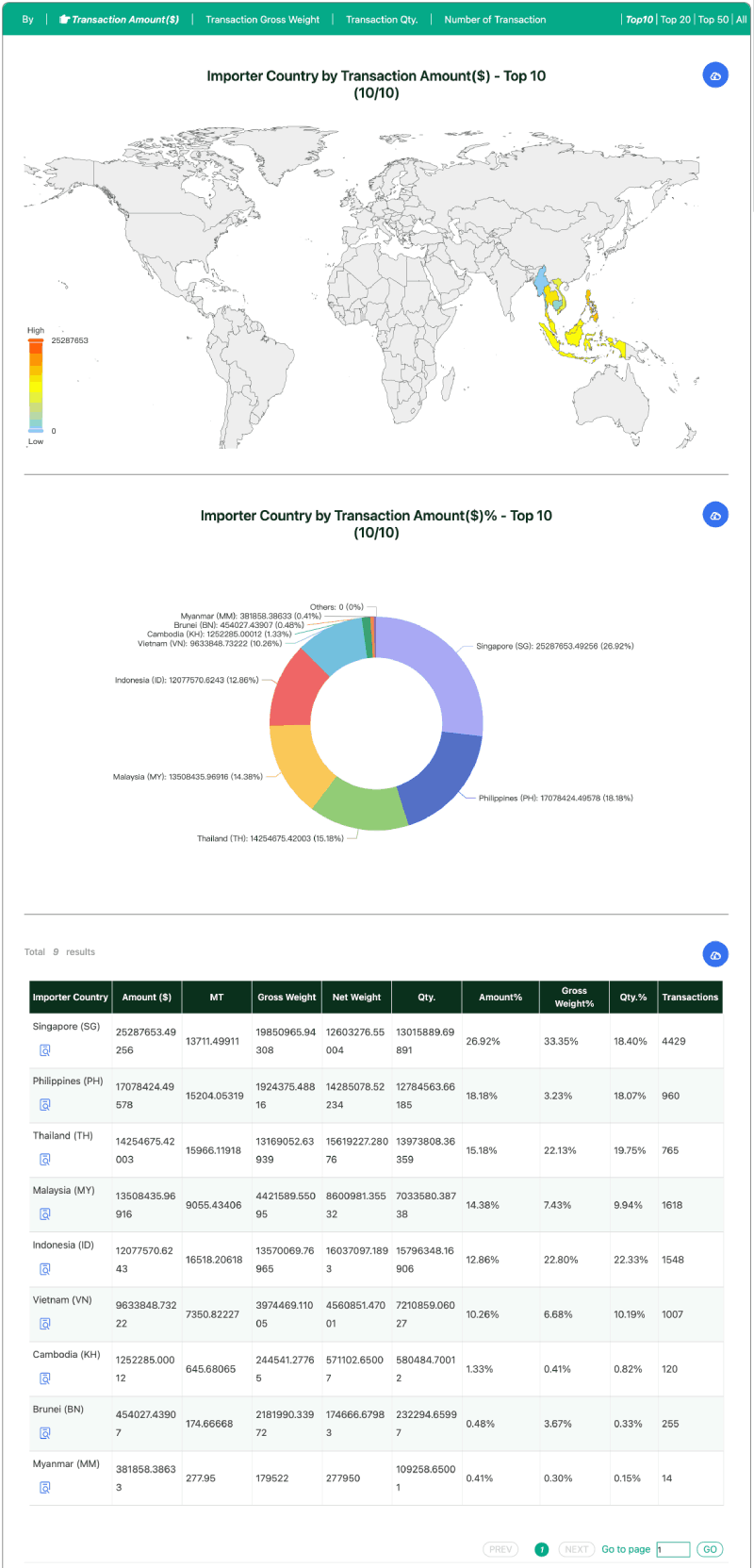

Discover active buyers, evaluate suppliers, monitor competitors, and uncover new market opportunities with ASEAN trade intelligence.